

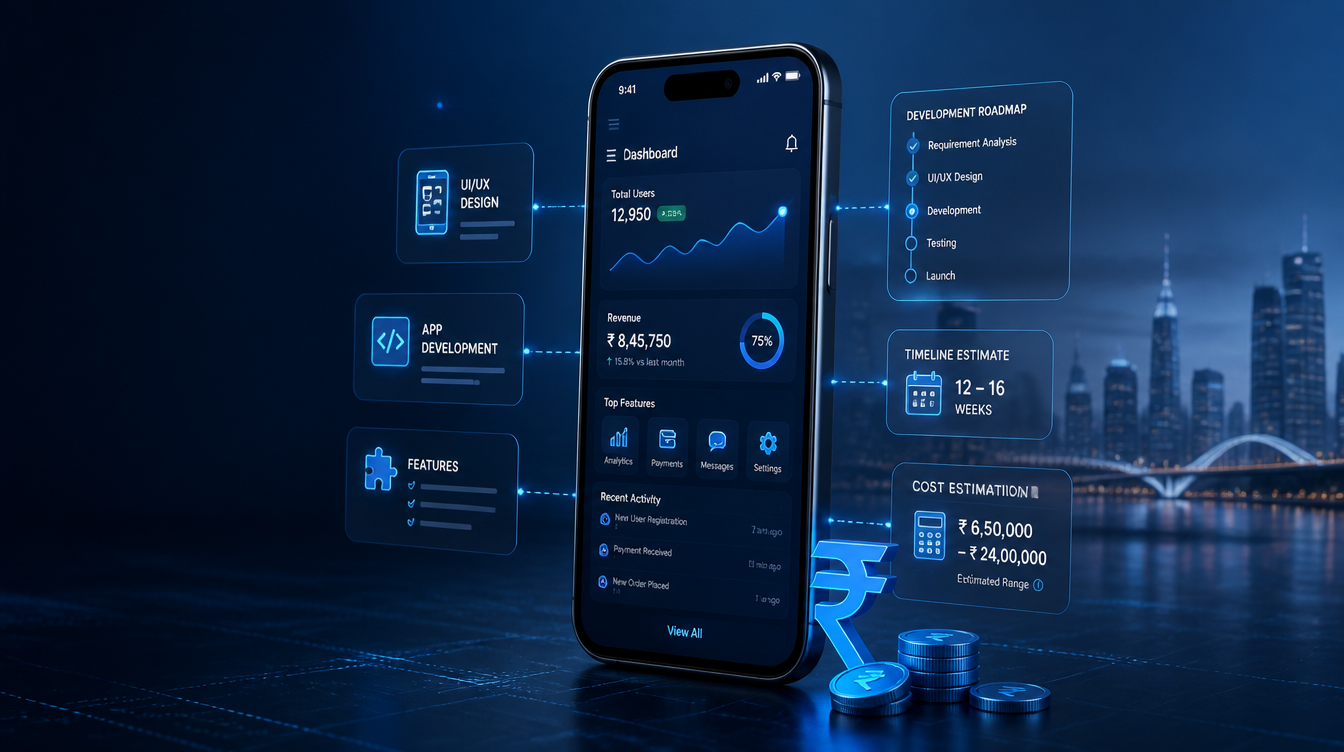
How Much Does Mobile App Development Cost in India in 2026?
Wondering how much mobile app development costs in India in 2026? This guide breaks down the real numbers by app type, feature set, and team structure — so you know exactly what to budget before you start.
The Number Everyone Asks First
Before a single wireframe is sketched or a line of code is written, the first question almost every business owner asks is: how much is this going to cost?
It is a fair question. And unlike the vague "it depends" answer you get from a lot of agencies, this post gives you actual numbers, broken down by app type, feature complexity, team model, and timeline.
Mobile app development in India in 2026 ranges from ₹1.5 lakhs for a basic single-feature app to ₹50 lakhs or more for a complex enterprise platform. But the right number for your project depends on a set of specific factors, all of which are covered below.
What Factors Actually Drive Mobile App Development Cost?
Cost is not random. It is the direct result of decisions made about scope, design, platforms, and team. Understanding these factors puts you in control of the budget from day one.
1. Type of App
A simple information or catalogue app has completely different requirements from a real-time logistics platform or a healthcare app with regulatory compliance built in. The more your app does, the more it costs to build it right.
2. Platform: Android, iOS, or Both
Building for one platform costs less than building for two. Cross-platform frameworks like Flutter or React Native allow you to build once and deploy on both Android and iOS, which is usually the most cost-effective approach for startups and mid-size businesses.
3. Number and Complexity of Features
Every feature adds to the timeline and cost. A basic login screen takes a few hours. A full social login system with OTP verification, biometric authentication, and role-based access takes significantly longer.
4. UI/UX Design Requirements
A generic interface built from standard components is faster and cheaper. A fully custom, branded experience with animations, micro-interactions, and a high-end visual design takes more time but delivers a stronger product.
5. Third-Party Integrations
Payment gateways, maps, SMS/email services, CRM tools, analytics platforms — every integration adds development time. More integrations means more cost.
6. Backend and Admin Panel
Most apps need a backend: a server-side system that stores data, runs business logic, and connects to the app. Some also need an admin dashboard where your team manages content, users, and orders. Both of these add to the total cost.
7. Testing and Quality Assurance
A professionally built app goes through structured testing: functional testing, device testing, performance testing, and security testing. This is not optional if you want a reliable product.
8. Post-Launch Maintenance
Apps need ongoing updates, bug fixes, compatibility updates as operating systems evolve, and new features as your business grows. Maintenance is a recurring cost that smart businesses plan for from the start.
Mobile App Development Cost Breakdown by App Type (India, 2026)
| App Type | Examples | Estimated Cost (INR) | Timeline |
|---|---|---|---|
| Basic app (single platform) | Portfolio app, catalogue, information app | ₹1.5L – ₹4L | 4 – 8 weeks |
| Simple two-sided app | Booking app, service directory, lead gen app | ₹4L – ₹8L | 6 – 10 weeks |
| E-commerce app | Online store with cart, payments, order tracking | ₹8L – ₹18L | 3 – 5 months |
| On-demand app | Food delivery, cab booking, home services | ₹15L – ₹35L | 4 – 7 months |
| Social or community app | Messaging, community, social networking | ₹12L – ₹30L | 4 – 8 months |
| Healthcare or fintech app | Telemedicine, digital banking, insurance platform | ₹20L – ₹60L+ | 6 – 12 months |
| Enterprise app | Internal tools, ERP, custom workflow platforms | ₹15L – ₹50L+ | 5 – 10 months |
| SaaS mobile product (MVP) | Subscription product sold to other businesses | ₹10L – ₹25L | 3 – 7 months |
Note: These ranges are estimates based on Indian development rates in 2026. Actual cost depends on your specific feature list, design requirements, and integrations.
Cost Breakdown by Development Stage
It helps to understand how the total cost is distributed across the phases of development.
| Phase | What Happens | Typical Cost Share |
|---|---|---|
| Discovery and planning | Requirement analysis, scope definition, technical roadmap | 5% – 8% |
| UI/UX design | Wireframes, visual design, prototype, user testing | 15% – 20% |
| Frontend development | App screens, navigation, user interactions | 25% – 35% |
| Backend development | APIs, database, server logic, admin panel | 25% – 35% |
| Testing and QA | Functional, performance, device, and security testing | 10% – 15% |
| Deployment and launch | App store submission, server setup, go-live | 3% – 5% |
| Post-launch support | Bug fixes, updates, minor enhancements (first 3 months) | Variable |
This breakdown shows why skipping phases like design or testing usually ends up costing more in the long run. Bugs found in production are far more expensive to fix than bugs caught during QA.
How Long Does It Take to Build a Mobile App?
Timeline is one of the most common questions businesses ask alongside cost. The honest answer is that timeline is directly tied to scope.
Here is a realistic guide:
| Project Scope | Estimated Timeline |
|---|---|
| Simple single-platform app | 4 – 8 weeks |
| Mid-complexity app (both platforms) | 3 – 5 months |
| On-demand or marketplace app | 5 – 8 months |
| Complex enterprise or regulated app | 6 – 12 months |
A few things that affect timeline beyond feature complexity:
- Feedback speed: The faster your team reviews and approves design and development milestones, the faster the project moves.
- Third-party dependencies: Waiting for API access, payment gateway approvals, or third-party integrations can add delays outside your development team's control.
- Scope changes mid-project: Adding features after development has started always adds time and cost. This is why the discovery phase matters so much.
- App store review: After development is complete, publishing on the Google Play Store typically takes 2 to 7 days. Apple's App Store review takes 1 to 3 days on average but can take longer for apps in certain categories.
Comparing Development Models: Freelancer vs Agency vs Dedicated Team
The team structure you choose is one of the biggest variables in both cost and quality. Here is an honest comparison.
| Factor | Freelancer | App Development Agency | Dedicated Development Team |
|---|---|---|---|
| Upfront cost | Lowest | Medium to High | Medium (scales with team size) |
| Availability and accountability | Variable | Structured | High, fully dedicated to you |
| Skill coverage | Limited to one or two skills | Full team available | Full team assigned to your project |
| Communication | Direct but inconsistent | Through a project manager | Consistent, integrated into your workflow |
| Scalability | Hard to scale | Can bring in more resources | Easy to scale up or down |
| Best for | Very small projects or single tasks | Full project with defined scope | Ongoing or evolving product |
| Risk level | Higher (dependency on one person) | Lower | Lowest |
Working with an app development company in Mohali gives you access to a structured, accountable team at Indian development rates, which are significantly lower than hiring the equivalent team in the US, UK, or Australia, without any compromise on quality.
Android vs iOS vs Cross-Platform: Which Affects Cost Most?
Platform choice has a direct and significant impact on your budget.
| Platform Choice | Relative Cost | Best For |
|---|---|---|
| Android only | Base cost | India-first products with Android-dominant user base |
| iOS only | Similar to Android | Premium products targeting iPhone users |
| Both (native) | 1.5x – 1.8x base cost | Large products that need platform-specific performance |
| Cross-platform (Flutter / React Native) | 1.2x – 1.4x base cost | Most startups and mid-size businesses — best value |
Flutter has become the dominant cross-platform framework in India for good reason. It produces near-native performance, supports both Android and iOS from a single codebase, and significantly reduces development time and cost. Most app development companies in Mohali and across India now default to Flutter for new projects unless there is a specific reason to go native.
Features That Add the Most to Your App Development Cost
Not all features are equal. Some have an outsized impact on cost. Knowing this helps you make smarter decisions when prioritising your feature list.
| Feature | Cost Impact | Why It Adds Cost |
|---|---|---|
| Real-time chat or messaging | High | Requires persistent connections, message storage, push notifications |
| Live tracking (GPS) | High | Continuous data updates, maps integration, battery optimisation |
| Video calling | Very high | Streaming infrastructure, latency management, security |
| Payment gateway integration | Medium-High | Security compliance, multiple gateway support, refund logic |
| AI or ML features | Very high | Model training, data pipelines, inference infrastructure |
| Social login (Google, Apple) | Low-Medium | OAuth flows for each provider |
| Push notifications | Low | Relatively standard, adds little cost |
| Multilingual support | Medium | Adds translation management and UI adaptation |
| Offline mode | Medium-High | Complex data sync logic |
| Admin dashboard | Medium | Separate interface built alongside the app |
The single most cost-efficient thing you can do before starting development is to separate your features into must-have for launch and nice to have later. Building a lean, focused first version and improving it based on real user data is almost always smarter than trying to build everything at once.
Why Indian App Development Costs Less — Without the Trade-Off
India is home to a large, experienced pool of software engineers, UI/UX designers, QA professionals, and project managers who work at rates substantially lower than their counterparts in Western markets.
| Country | Average App Development Rate (per hour) |
|---|---|
| United States | $100 – $200 |
| United Kingdom | $70 – $150 |
| Australia | $80 – $150 |
| India | $15 – $50 |
| Eastern Europe | $40 – $80 |
This does not mean Indian development is lower quality. Indian developers and engineers work on projects for global companies every day. The cost difference comes from a lower cost of living and operational costs, not from a difference in skill or output.
Choosing an app development company in India — particularly one in a city like Mohali, which has a growing and established technology ecosystem — gives you high-quality output at a fraction of what you would pay in Western markets.
Hidden Costs to Account for in Your App Budget
Many businesses underestimate the full cost of launching and maintaining an app because they only account for development. Here are the costs that frequently catch people off guard.
App store fees:
- Google Play Store: One-time registration of approximately ₹2,000
- Apple App Store: Annual fee of approximately ₹8,000 per year
Hosting and infrastructure:
Cloud hosting (AWS, Google Cloud, or Azure) for your backend typically costs ₹3,000 to ₹30,000 per month depending on traffic and data volume.
Third-party API costs:
Maps (Google Maps API), SMS gateways (Twilio, MSG91), payment gateways (Razorpay, PayU) — all have usage-based charges that increase as your user base grows.
Annual maintenance:
Plan for 15% to 25% of your original development cost per year for updates, compatibility fixes, and minor enhancements.
Security and compliance:
Apps in healthcare, fintech, or edtech may require security audits, data protection compliance work, or third-party certifications that add to the total cost.
How to Get an Accurate Quote for Your App
A responsible development company will not give you a final price without first understanding your project properly. Be cautious of companies that quote a number before asking a single question about your requirements.
What you should prepare before getting a quote:
- A clear description of what your app does and who it is for
- A rough list of the features you need for launch
- The platforms you need to support (Android, iOS, or both)
- Any existing tools or systems your app needs to connect with
- A realistic timeline if you have a deadline in mind
- A rough sense of your budget range (even approximate)
A good development team will use this information to give you a scoped estimate and a phased development plan, so you can see exactly what you are getting for your budget.
Why Businesses in Punjab Choose Mohali for App Development
The technology ecosystem in Mohali has grown substantially over the past decade. The city sits within the Chandigarh-Mohali-Panchkula tricity, which has become one of the stronger IT hubs in North India.
Businesses across Punjab — in Ludhiana, Amritsar, Jalandhar, and Chandigarh — regularly work with app development companies in Mohali because of the combination of proximity, communication, technical capability, and cost.
Advantages of working with an app development company in Mohali:
- Same time zone, same working hours — no coordination overhead
- Ability to meet in person for key discussions and reviews
- Strong understanding of local market needs and user behaviour
- Competitive rates compared to metro-city agencies in Delhi, Bangalore, or Mumbai
- Experienced teams that have worked on projects for clients across India and internationally
Frequently Asked Questions
The cost ranges from ₹1.5 lakhs for a basic single-platform app to ₹60 lakhs or more for a complex, regulated, or enterprise-grade application. The most common range for a mid-complexity app (both Android and iOS, with standard features like user accounts, payments, and notifications) falls between ₹8 lakhs and ₹18 lakhs. The actual number depends on your feature list, platforms, design requirements, and integrations.
A simple app can be ready in 4 to 8 weeks. A mid-complexity app typically takes 3 to 5 months. On-demand platforms, marketplace apps, or enterprise applications take 5 to 12 months. Timeline is directly tied to the scope of the project. The more features you add, the longer it takes. The most reliable way to get an accurate timeline is to go through a proper discovery process with your development team before any build work begins.
Yes, in most cases. Using a cross-platform framework like Flutter or React Native, a single codebase is written that runs on both Android and iOS. This typically costs 20% to 40% more than building for just one platform, but significantly less than building two completely separate native apps (which can cost 1.5x to 1.8x the price of one). For most startups and small to mid-size businesses, Flutter is the recommended approach.
An MVP (Minimum Viable Product) is the simplest version of your app that includes only the core features needed to deliver value to your first users and test whether the product works in the market. An MVP typically costs 30% to 60% of what the full vision would cost to build. Starting with an MVP is usually the smarter approach — it gets you to market faster, lets you gather real user feedback, and reduces the risk of building features no one actually uses.
With a professional app development company, yes. You should own the full source code, design files, and all intellectual property related to the app. Make sure this is clearly stated in your contract before development starts. Avoid any arrangement where the agency retains ownership of the code.
Plan for the following recurring costs: cloud hosting (₹3,000 to ₹30,000+ per month depending on scale), Apple App Store annual fee (approximately ₹8,000 per year), third-party API charges (varies by usage), and annual maintenance (typically 15% to 25% of your original development cost). Maintenance covers bug fixes, operating system compatibility updates, security patches, and minor feature additions.
Look for a company with a portfolio that includes apps similar to what you want to build. Ask about their development process — do they start with a proper discovery phase? Do they show you working prototypes before starting full development? Check client reviews, not just on their own website but on third-party platforms like Google or Clutch. Make sure they are transparent about pricing and have a clear contract that covers ownership, timelines, and what happens if requirements change.
Yes, but it requires being very deliberate about scope. The key is to decide which features are essential for your first version and build only those. A focused, well-built app with five core features is far more valuable than a rushed app with twenty half-built features. A good development team will help you identify what truly needs to be in version one and what can come later.
The Bottom Line
Mobile app development in India offers some of the best value in the world, but cost without context is just a number. The right budget for your app is the one that gets the right features built, on time, with the quality your users will trust.
Before you start comparing quotes, invest time in defining what your app needs to do, who it is for, and what success looks like six months after launch. That clarity is what separates projects that deliver real business value from ones that stall, overshoot their budget, or launch and then sit unused.
If you are planning a mobile app and want a realistic, transparent estimate for your specific idea, the right first step is a conversation with a team that asks the right questions.
Written by the team at Bhanguz Software Solutions, an app development company in Mohali with 19+ years of experience building mobile apps, web platforms, and custom software for businesses across India and internationally.
Related articles

Published June 11, 2026
How Bhanguz Builds Powerful Offshore Web Solutions Using MEAN, MERN, PHP & Flutter
 Author Name
4 min read

Published May 14, 2026
How Bhanguz Conducts Requirement Analysis for Every Project
Author Name
4 min read
