

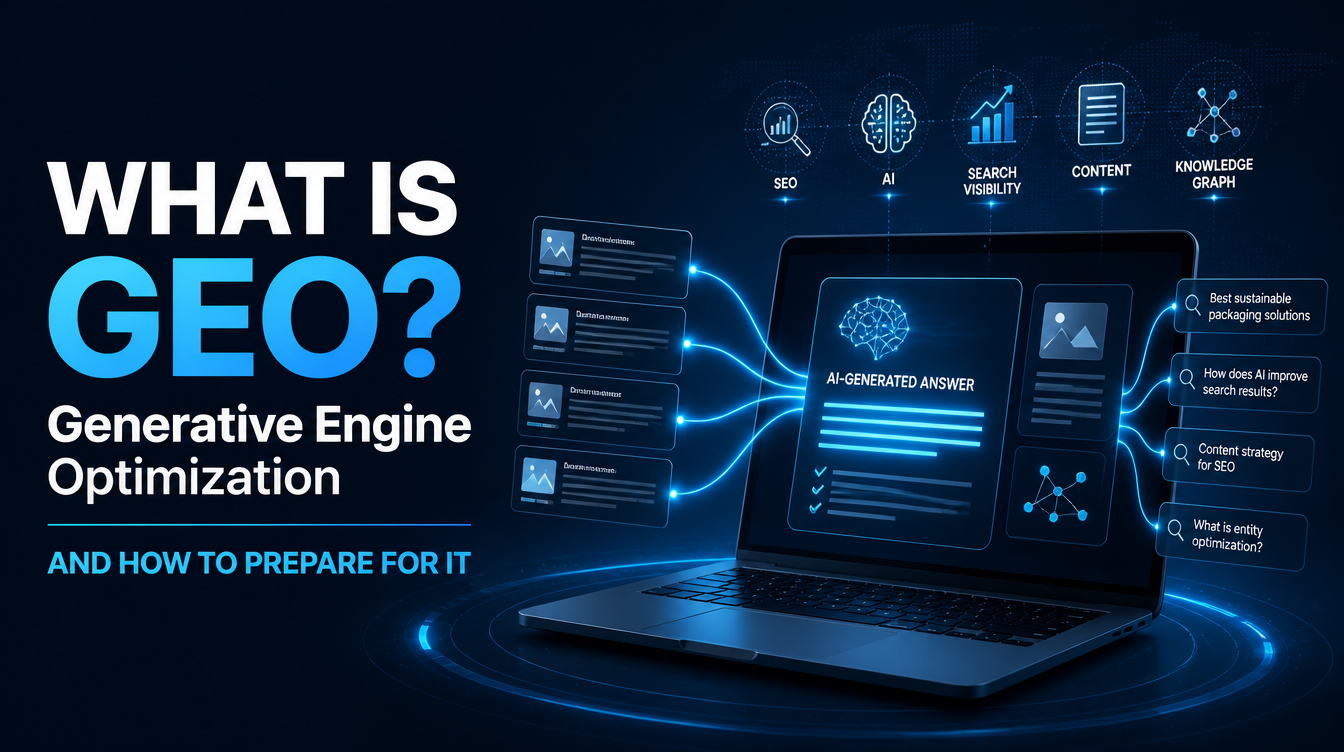
What is GEO (Generative Engine Optimization) and How to Prepare for It
GEO, or Generative Engine Optimization, is the practice of making your business visible inside AI-generated answers from tools like ChatGPT, Gemini, and Perplexity. Here is what it is, why it matters, and exactly how to prepare for it in 2026.
A New Kind of Search Is Taking Over
When someone asks ChatGPT "which software company in Mohali should I hire for my project," ChatGPT does not open Google and scroll through results. It generates an answer using information it has already learned and sometimes supplements it with live web data.
If your business is not in that answer, you do not exist to that user. Not because your website is bad. Not because your SEO is weak. But because the AI simply does not know enough about you to mention you.
That is the problem Generative Engine Optimization (GEO) is designed to solve.
What is GEO?
GEO, or Generative Engine Optimization, is the practice of building your brand's online presence in a way that large language models (LLMs) and generative AI tools can find, trust, and cite your business when generating answers for users.
Think of it this way. Traditional SEO helps Google rank your website. AEO (Answer Engine Optimization) helps your content appear in featured snippets and AI Overview boxes. GEO goes a layer deeper. It is about making sure your brand is part of what AI tools already know, so they mention you unprompted when a relevant question is asked.
The tools you are optimizing for with GEO include:
- ChatGPT and GPT-powered search (SearchGPT)
- Google Gemini and Google's AI Overviews (SGE)
- Perplexity AI
- Microsoft Bing Copilot
- Claude by Anthropic
- Any AI assistant that pulls information from the web or from pre-trained datasets
GEO vs SEO vs AEO: What Is the Difference?
These three terms come up together often, and they are related but not the same thing.
| Factor | SEO | AEO | GEO |
|---|---|---|---|
| Full name | Search Engine Optimization | Answer Engine Optimization | Generative Engine Optimization |
| Primary goal | Rank on Google and Bing | Appear in featured snippets and AI answer boxes | Get cited in AI-generated responses |
| Main tools | Google, Bing | Google AI Overviews, Siri, Alexa | ChatGPT, Gemini, Perplexity, Copilot |
| Key signals | Backlinks, keywords, page speed | Structured content, FAQ schema, E-E-A-T | Brand mentions, entity data, third-party citations |
| Output type | A ranked list of links | A direct answer pulled from one source | A paragraph or recommendation generated by AI |
| How users interact | Click a link to visit your site | Read the answer without clicking | Accept the AI recommendation directly |
The important thing to understand is that all three work together. A strong SEO foundation makes AEO and GEO possible. But GEO requires signals that go far beyond your own website.
Why GEO Matters Right Now
AI-powered search tools processed billions of queries in 2024. That number is growing fast in 2026, particularly in markets like India where mobile-first users are adopting AI assistants at a rapid pace.
Here is why GEO is urgent for businesses right now:
Users trust AI recommendations. When ChatGPT recommends a software development company, users treat it similarly to a word-of-mouth referral. The recommendation carries weight.
The window to get in early is open. Most businesses, including most of your local competitors, have not thought about GEO yet. Getting mentioned by AI tools now, before the space becomes crowded, is a real competitive advantage.
AI does not automatically know about you. Unless your brand is discussed across multiple credible online sources, AI tools will either not know you exist or will have incomplete information about you. GEO is the work of filling in that picture.
Zero-click search is growing. More and more users are getting answers directly from AI without clicking any link at all. If you are not part of that answer, you have no presence for that query.

How Do LLMs Actually Decide What to Recommend?
This is the question most business owners ask first. Understanding how LLMs work helps explain what GEO actually does.
Large language models like GPT-4, Gemini, and Claude are trained on enormous amounts of text from the internet. They learn associations between brands, services, locations, and reputations from the content they are trained on.
When a user asks a question, the model generates an answer based on:
- What it learned during training from web content, books, forums, and databases
- Live web retrieval (in tools like Perplexity and SearchGPT) that pulls from current pages
- Entity graphs that connect brand names to their services, location, and reputation
- The volume and credibility of sources that mention a brand in context
This means GEO is not about tricking an AI. It is about genuinely being present across the web in a way that gives AI tools enough signal to confidently recommend your business.
The Core Pillars of GEO
1. Entity-Based SEO
An entity is a clearly defined thing that AI and search engines can identify and categorize. Your business is an entity. Your services are entities. Your location, your founders, your products are all entities.
Entity-based SEO means making sure that your business is clearly defined across the internet as a distinct, identifiable entity with consistent attributes.
What this looks like in practice:
- Your business name, address, phone number, and description are exactly the same on every platform
- Your website has Organization schema markup that tells search engines what your business is, where it is, and what it does
- You have profiles on structured data sources like Google Business Profile, LinkedIn, Crunchbase, and industry directories
- Your services are named consistently and described in the same way across your website, social profiles, and third-party listings
2. Building LLM Visibility Through Third-Party Mentions
Your own website is just one source. AI tools learn about businesses from many sources simultaneously.
To build LLM visibility for your business, you need to be talked about in places the AI trusts:
- Industry publications and media: Getting featured in or quoted by tech blogs, business news sites, and industry publications teaches AI tools to associate your brand with expertise
- Review platforms: Google Reviews, Clutch, G2, Trustpilot, and Justdial are sources that AI tools reference to understand reputation
- Wikipedia and Wikidata: For businesses prominent enough to qualify, these are among the highest-trust sources that LLMs reference
- Forums and communities: Reddit, Quora, LinkedIn groups, and niche forums where real people discuss and recommend businesses are read by AI systems
- Guest posts and contributed content: Publishing expert articles on other websites creates AI-visible signals that your brand has domain knowledge
3. Structured Data for AI Search
Structured data is code added to your website that does not change what users see but dramatically changes what machines understand.
When you add structured data to your pages, you are telling AI systems and search engines exactly what your content means, not leaving them to guess.
Types of structured data that matter most for GEO:
- Organization schema: Defines your business name, location, founding date, services, social profiles, and contact details
- LocalBusiness schema: Signals your physical location and service area to AI tools handling local queries
- FAQPage schema: Marks up question-and-answer content so AI tools can pull it directly
- Article schema: Tells AI systems that your content is a published article with a specific author, topic, and publication date
- Service schema: Defines each service you offer with a clear name, description, and area of availability
- BreadcrumbList schema: Helps AI understand the structure of your website
Without structured data, AI tools have to infer these things. With it, you are giving them direct, reliable information.
4. Content That AI Can Summarize and Cite
AI tools do not just link to pages. They summarize them and cite them in generated responses. For your content to be GEO-friendly, it needs to be easy for an AI to read, extract, and quote.
What that means for your content:
- Write clear definitions at the start of key sections. When an AI needs to explain a concept, it often reaches for the first clean definition it can find.
- Use direct question-and-answer formatting. FAQ sections, especially those using FAQPage schema, are highly quotable by AI tools.
- Keep your language factual and verifiable. AI tools are trained to prefer content that can be cross-checked. Opinions and vague claims are harder for AI to confidently cite.
- Include specific details. Prices, timelines, locations, technology stacks, case study numbers. Specificity is something AI tools look for when evaluating whether a source is authoritative.
- Structure content with clear headings. H1, H2, H3 hierarchy helps AI tools understand the outline of your content and pull the right sections for the right questions.
5. E-E-A-T Signals for GEO
E-E-A-T stands for Experience, Expertise, Authoritativeness, and Trustworthiness. Google invented the framework to evaluate content quality, but AI tools use similar signals when deciding whether to trust and cite a source.
How to build E-E-A-T signals for GEO:
- Add clear author bios to every piece of content, with credentials and links to the author's LinkedIn or other professional profiles
- Display your team's experience and qualifications on your website
- Show real case studies with specific results, not just vague testimonials
- Collect and display genuine reviews from verified customers
- Maintain an updated, professional presence on LinkedIn and other platforms
- Make it easy to verify your business is real: address, phone number, registration details, years in operation
6. Local GEO for Indian Businesses
For businesses in India, especially in tier-2 and tier-3 cities, local GEO is a strong opportunity.
When a user asks an AI tool "which IT company in Mohali can build a mobile app for my startup," the AI generates an answer based on what it knows about IT companies in Mohali. If your business is well-documented across local directories, Google Business Profile, and local media, you have a meaningful shot at appearing in that answer.
Local GEO actions that make a difference:
- Keep your Google Business Profile complete, accurate, and regularly updated
- Get listed on Justdial, Sulekha, IndiaMart, and other India-specific platforms
- Collect reviews on multiple local platforms, not just Google
- Publish content that specifically references your location, the industries you serve locally, and the types of clients you have worked with in your region
- Get mentioned in local business news, city-specific blogs, or regional industry directories
Step-by-Step: How to Start Preparing for GEO Today
You do not need to do everything at once. Here is a practical sequence for getting started.
Step 1: Audit your entity presence
Search for your business name on Google, ChatGPT, and Perplexity. See what comes up. Note what is missing, what is incorrect, and where you are not showing up at all.
Step 2: Fix your NAP consistency
NAP stands for Name, Address, Phone number. Check that these are identical across your website, Google Business Profile, LinkedIn, and every directory you are listed on. Inconsistency confuses AI tools.
Step 3: Add structured data to your website
Start with Organization schema on your homepage, FAQPage schema on any FAQ sections, and LocalBusiness schema if you serve a specific geographic area.
Step 4: Create content built around questions
Write content that directly answers the questions your target customers ask. Use clear headings that are the question itself. Give a short, direct answer immediately, then expand.
Step 5: Build third-party mentions
Identify five to ten credible platforms where your business should be mentioned or listed and does not appear yet. Focus on platforms that AI tools are known to index: Clutch, G2, LinkedIn, Google Business Profile, industry associations.
Step 6: Publish author-attributed content
Start putting real names and bios on your blog posts and articles. An AI is more likely to cite content from a named, credible expert than from a nameless company blog.
Step 7: Monitor your AI search presence
Check periodically what AI tools say about your business and your industry. Tools like Perplexity allow you to see live citations. Note who is being cited and what kind of content gets pulled.
Common GEO Mistakes Businesses Make
Relying only on your own website.
GEO is fundamentally about third-party presence. If AI tools only find your website talking about you, they do not have enough confirmation to confidently recommend you.
Keyword stuffing instead of entity building.
Repeating your target keyword fifty times on a page does not help with GEO. Building a coherent, consistent entity presence across many sources does.
Ignoring review platforms.
Reviews are one of the ways AI tools evaluate reputation. A business with zero reviews on Clutch, G2, or Google is less likely to be recommended by an AI tool than a competitor with fifty verified reviews.
Not using structured data.
Structured data is one of the clearest signals you can send to AI systems. Skipping it leaves your content harder to parse and less likely to be cited accurately.
Publishing vague, generic content.
AI tools are more likely to cite content with specific facts, figures, and expertise signals. Content that says "we are the best" without showing proof is the least GEO-effective kind of content.
How GEO Connects to Your Overall Digital Marketing Strategy
GEO does not replace traditional SEO services or digital marketing. It builds on them.
A business with strong SEO has the technical foundation that makes GEO work. A business with good AEO content has the question-and-answer structures that AI tools love to cite. And a business with a clear GEO strategy is building the brand presence that AI tools need to confidently recommend it.
For businesses in Chandigarh, Mohali, and across Punjab, working with an AI SEO agency that understands all three layers, including how to optimize for Google SGE, how to build LLM visibility for businesses, and how to create content that AI tools can cite, is the most effective way to stay competitive as search continues to change.
Frequently Asked Questions
Generative Engine Optimization (GEO) is the practice of optimizing your brand's online presence so that AI tools like ChatGPT, Google Gemini, and Perplexity mention and recommend your business when generating answers for users. It involves building entity presence, earning third-party citations, adding structured data, and creating content that AI systems can accurately summarize and cite.
Traditional SEO helps your website rank on search engine results pages. GEO focuses on making your brand visible inside AI-generated answers. SEO targets algorithms that rank pages. GEO targets language models that generate responses. Both are necessary, and they complement each other.
There is no single switch to flip. The most effective approach is to build your brand's presence across multiple credible sources: review platforms, industry directories, third-party publications, social profiles, and structured data on your website. The more places an AI tool can find consistent, credible information about your business, the more likely it is to include you in a generated answer.
Yes. Small businesses targeting specific local queries often have an advantage in GEO because the competition in AI-generated local answers is lower than in national or global searches. A well-optimized local presence can put a small business in AI answers that larger competitors overlook.
GEO results typically take three to six months to become visible. Some actions, like adding structured data or completing your Google Business Profile, can have faster effects. Building third-party citations and earning media coverage is a longer process but creates more durable results.
Entity-based SEO is the practice of building a clear, consistent digital identity for your business as a named entity that AI systems and search engines can identify and categorize. It involves consistent NAP data, structured data markup, complete profiles on authoritative platforms, and content that clearly defines what your business is, what it does, and where it operates.
Yes. Structured data, particularly Organization schema, FAQPage schema, and LocalBusiness schema, gives AI systems direct, reliable information about your business instead of requiring them to infer it. It is one of the most actionable GEO steps you can take immediately.
The Bottom Line
GEO is not a replacement for SEO. It is the next layer of it.
Search is no longer just about ranking on page one. A growing portion of discovery now happens inside AI-generated answers that users read without clicking a single link. If your business is not part of those answers, you are losing visibility in a channel that is growing faster than any other in search right now.
The good news is that the path to GEO visibility is clear: build a consistent entity presence, earn third-party mentions, add structured data, create content that AI can quote, and make sure every platform that matters has accurate, complete information about your business.
The businesses that do this work now will have a meaningful head start as generative AI becomes the default way people find what they are looking for.
Written by the team at Bhanguz Software Solutions, an AI SEO agency and digital marketing agency in Mohali with 19+ years of experience helping businesses grow their online presence across India and internationally.
Related articles

Published June 11, 2026
How Bhanguz Builds Powerful Offshore Web Solutions Using MEAN, MERN, PHP & Flutter
 Author Name
4 min read

Published May 14, 2026
How Bhanguz Conducts Requirement Analysis for Every Project
Author Name
4 min read
