


AI Creates Content, Humans Create Connection: Why Both Matter for Your Business
AI can produce content faster than ever, but it cannot build trust, relationships, or brand loyalty. Learn why human creativity and connection are still the most important ingredients in digital marketing.
The Content Machine Is Running
Businesses are generating more content today than at any point in history. Blog posts, social media captions, email newsletters, product descriptions, ad copy, all of it can now be produced in seconds using AI tools like ChatGPT, Gemini, and others.
This sounds like a dream for marketers. And in some ways, it is.
But there is a gap that keeps growing between the volume of content being created and the actual engagement that content receives. More content is being published. Less of it is being remembered.
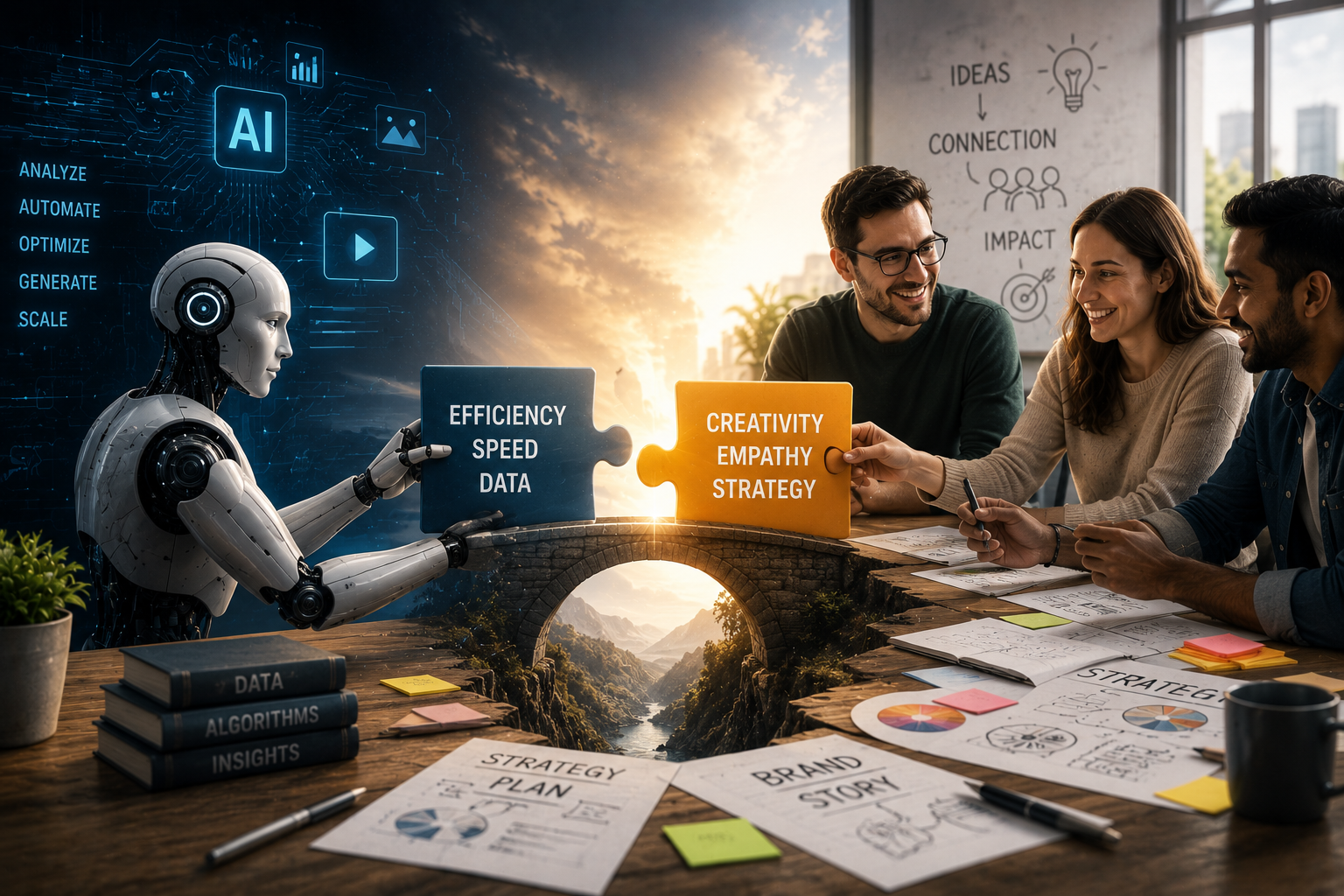
The reason is straightforward. AI creates content. Humans create connection.
What AI Does Well
To be fair, AI tools have genuinely changed what is possible for businesses. Here is what they do particularly well.
Where AI adds real value in content creation:
- Drafting first versions of long-form blog posts and articles
- Generating product descriptions at scale
- Creating multiple ad copy variations for A/B testing
- Summarizing research and data into readable formats
- Translating and repurposing content across languages
- Maintaining consistency in tone when given clear guidelines
- Speeding up repetitive writing tasks significantly
For businesses that previously had no content at all, AI lowers the barrier to entry. A company in Mohali or Chandigarh that could not afford a full-time content writer can now produce basic content regularly.
That is a real benefit.
What AI Cannot Do
Here is where things get more nuanced. AI can write a sentence. It cannot mean it.
When a customer reads a post written entirely by AI, something is often slightly off. It is grammatically correct. It covers the right points. But it does not feel like it came from a person who actually cares about the topic or the reader.
What AI lacks in content creation:
- Genuine lived experience and personal insight
- Cultural nuance and local context (especially important for regional businesses in Punjab and Chandigarh)
- Emotional intelligence in how a message lands
- The ability to sense what a specific audience needs right now
- Authentic brand voice that reflects real values and real people
- Relationship memory (knowing a returning customer vs. a new one)
- Ethical judgment about what should and should not be published
A branding agency in Chandigarh working with a local business understands things an AI never will: the community, the trust dynamics, the language preferences, the local competitors, and the specific stories that make that brand worth paying attention to.
AI Content vs Human-Led Content: A Comparison
| Dimension | AI-Generated Content | Human-Led Content |
|---|---|---|
| Speed of production | Very fast | Slower |
| Cost at scale | Low | Higher |
| Consistency | High | Can vary |
| Originality | Based on existing data | Can be truly original |
| Emotional resonance | Limited | Strong when done well |
| Cultural and local relevance | Often generic | Precise when writer knows the audience |
| Brand authenticity | Difficult to achieve | Natural with the right writer |
| Trust-building over time | Weak | Strong |
| Adaptability to current events | Requires prompting | Instinctive |
| Ability to surprise and delight | Rare | Regular |
The pattern here is clear. AI wins on efficiency. Humans win on meaning.
The smartest content strategies use both.
Why Connection Is the Real Currency of Marketing
Marketing has always been about getting someone's attention and then earning their trust. That has not changed.
What has changed is how difficult it is to earn attention now. Users are exposed to hundreds of pieces of content every day. Most of it gets ignored. The content that cuts through is the content that feels real, specific, and human.
Think about the brands you personally trust. You probably trust them because at some point, someone behind that brand communicated with you in a way that felt genuine. A reply that actually addressed your issue. A blog post that seemed to understand your exact problem. A campaign that reflected something real about the culture you live in.
That is connection. And connection cannot be automated.
How connection shows up in digital marketing:
- A social media comment that gets a real, thoughtful reply
- A blog post written from genuine experience, not just research
- An email that references something specific about where you are or what you need
- A brand that takes a clear position on something its audience cares about
- Customer service that resolves a problem without making the customer feel like a ticket number
The Right Way to Use AI in Content Marketing
The question is not whether to use AI. Most businesses already are, or will be soon. The question is how to use it without losing what makes your brand worth following.
A practical framework for using AI in content:
- Use AI for research and drafting - Let AI gather information, generate outlines, and produce first drafts. This saves time.
- Have a human review for accuracy and tone - A person who knows your brand and your audience should edit every piece before it goes out.
- Add original insight - Include something AI cannot know: a real case study, a specific client story, an opinion your team actually holds.
- Optimize for AI search - Ironically, content that performs well in AI-powered search (AEO and GEO) needs to be clear, structured, and authoritative. That takes human judgment to achieve.
- Distribute with a human strategy - Where you publish, when you publish, and how you engage after publishing all require decisions that context-aware humans make better than automated tools.
Why This Matters Especially for Local and Regional Businesses
For businesses in Punjab, Chandigarh, and Mohali competing in both local and national markets, the human element in content is even more important.
Your local audience can tell the difference between content that understands them and content that was clearly produced by a generic AI tool with no knowledge of their region, language preferences, or business culture.
A digital marketing agency that knows Chandigarh does not just write about digital marketing. It understands what local business owners worry about, how purchasing decisions are made in this market, what competitors are doing, and what tone of voice earns trust here.
That local intelligence is not something you can prompt into an AI. It comes from experience, presence, and genuine engagement with the community.
What Happens When Businesses Rely Entirely on AI Content
There is an increasing number of businesses that have gone all-in on AI-generated content: posting daily, flooding every channel, publishing at a pace no human team could sustain.
The short-term numbers sometimes look good. More content means more indexable pages, more social posts, more touchpoints.
But the longer-term pattern is more revealing.
Common problems with fully AI-dependent content strategies:
- Audience engagement drops over time as content becomes predictable and generic
- Brand identity becomes blurry when no consistent human voice exists
- Errors and inaccuracies go unchecked because no human review process exists
- Customer trust erodes when it becomes obvious no real person is behind the content
- Google and AI search engines are increasingly rewarding content with real E-E-A-T signals (Experience, Expertise, Authoritativeness, Trustworthiness), which pure AI content struggles to demonstrate
Frequently Asked Questions
Yes, but with human oversight. AI works well for drafting, research, and scaling routine content. Human editors should review everything before publishing to ensure accuracy, brand voice, and genuine value.
Google's stance is that it evaluates content quality, not how it was produced. Helpful, accurate, well-structured content can perform well whether written by a human or AI. The problem is that purely AI-generated content often lacks the real-world experience signals (E-E-A-T) that Google now prioritizes heavily.
LLMs and AI search tools look for content that is authoritative, specific, and trustworthy. Content written by real experts with real experience tends to rank better because it contains the kind of specific, credible detail that AI training data values. Generic AI content often looks and reads like every other piece on the same topic.
There is no universal ratio, but a practical approach is to use AI for about 60 to 70 percent of the production work (research, drafts, formatting) while humans handle strategy, editing, original insight, and final review.
The Bottom Line
AI is a production tool. A very powerful one. But production is not the same as communication, and communication is not the same as connection.
The businesses that will stand out over the next few years are not the ones that produce the most content. They are the ones whose content makes people feel something real: understood, informed, or inspired to take action.
AI can help you get there faster. But the direction, the voice, and the relationship still have to come from people.
If you want a content and digital marketing strategy that combines the efficiency of AI with the authenticity of human expertise, Bhanguz Software Solutions Pvt. Ltd. can help. Contact us to learn more about our digital marketing and branding services.
Written by the team at Bhanguz Software Solutions Pvt. Ltd., a digital marketing and branding agency in Chandigarh and Mohali with 19+ years of experience helping businesses build stronger brands and smarter digital strategies.
Related articles

Published June 11, 2026
How Bhanguz Builds Powerful Offshore Web Solutions Using MEAN, MERN, PHP & Flutter
 Author Name
4 min read

Published May 14, 2026
How Bhanguz Conducts Requirement Analysis for Every Project
Author Name
4 min read
