

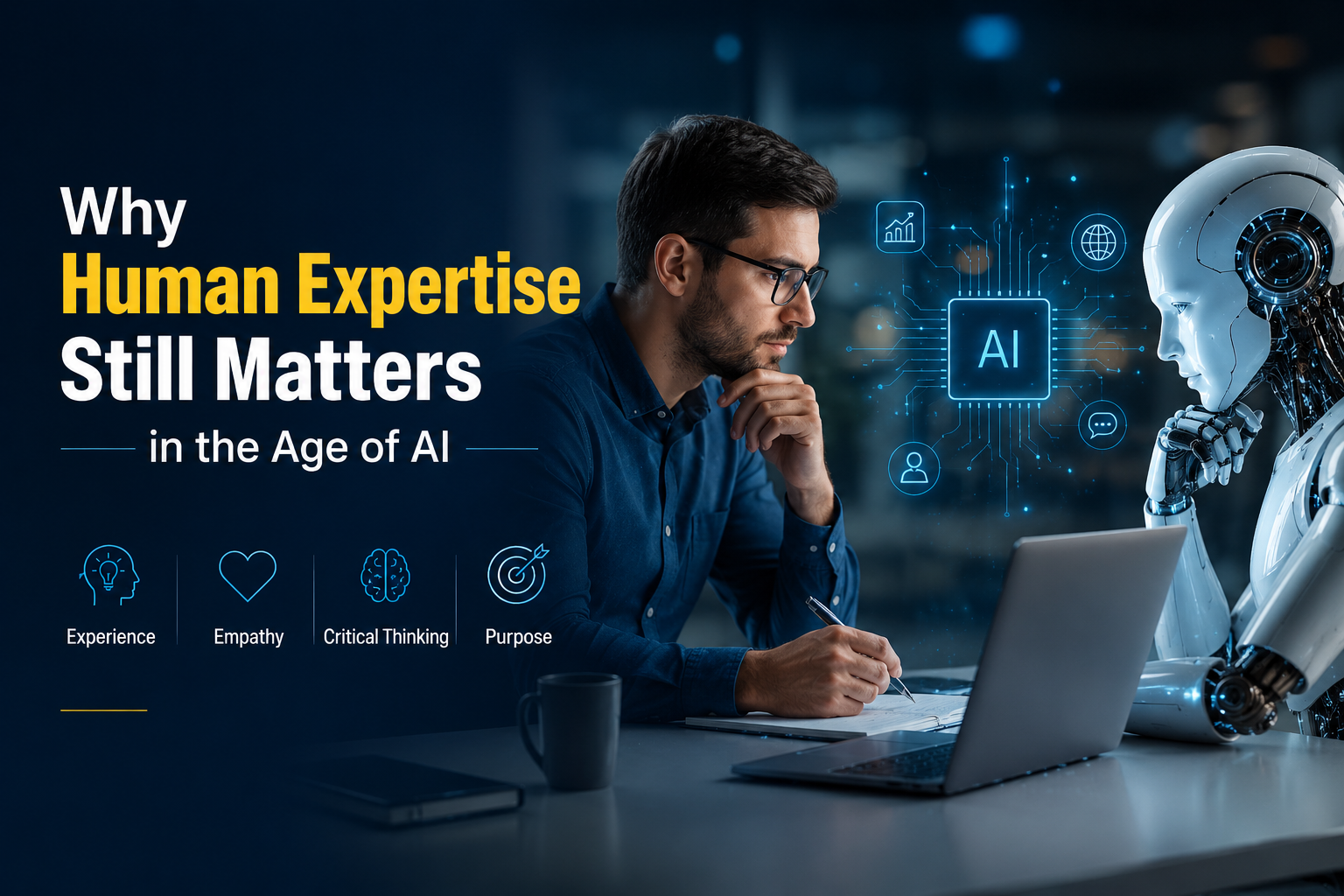
Why Human Expertise Still Matters in the Age of AI
AI can process data and generate outputs faster than any human. But expertise, judgment, and accountability are still human qualities. Here is why they matter more than ever in an AI-driven world.
The Smarter the Tools Get, the More Judgment Matters
AI tools are genuinely impressive. They can write code, generate designs, analyse datasets, draft legal documents, and answer complex questions in seconds. For businesses, this represents a real shift in what is possible with smaller teams and lower budgets.
But here is something worth thinking about: as AI tools become more capable of producing outputs, the ability to evaluate those outputs becomes the most valuable skill in the room.
Who decides if the AI-generated strategy is actually right for this specific client in this specific market? Who catches the edge case the AI missed? Who takes responsibility when something goes wrong?
The answer, every time, is a person with genuine expertise.
This is why human expertise is not becoming less relevant in the age of AI. In many ways, it is becoming more important.
What AI Does That Humans Used to Do
To understand why expertise matters more now, it helps to be clear about what AI has actually taken over.
Tasks AI now handles that previously required significant human time:
- Drafting content across formats (blogs, emails, reports, ad copy)
- Writing and reviewing code at a basic to intermediate level
- Answering frequently asked questions in customer service
- Generating design mockups and visual variations
- Processing and summarising large volumes of data
- Translating content across languages
- Running basic market research and keyword analysis
- Producing financial models from structured data
These are real productivity gains. Businesses that use AI for these tasks move faster and spend less on routine work.
But note what all of these tasks have in common: they produce an output that then needs to be evaluated, refined, and applied correctly. That evaluation and application is where expertise lives.
What AI Cannot Replace
There are specific qualities that human experts bring that AI tools, at their current stage, genuinely cannot replicate. These are not vague or sentimental points. They are practical capabilities that drive business outcomes.
Human expertise that AI cannot replace:
- Contextual judgment - Understanding that a solution which worked for one client in one industry will not work the same way for another
- Accountability - A real person can be held responsible, can apologise, can make something right
- Ethical reasoning - Knowing when the right action is not the most efficient one
- Relationship intelligence - Reading what a client actually needs versus what they are asking for
- Creative leaps - Making unexpected connections between ideas in genuinely novel ways
- Domain depth - Knowing an industry well enough to spot what is missing or wrong in an AI-generated output
- Adaptive communication - Adjusting how you explain something based on who is in the room and what they already understand
- Risk assessment - Understanding what could go wrong in a real-world context, not just a theoretical one
Human Expertise vs AI Capability: A Practical Comparison
| Situation | What AI Offers | What Human Expertise Adds |
|---|---|---|
| Building a software product | Code generation, boilerplate, documentation | Architecture decisions, security review, client-specific logic, scalability planning |
| Running an SEO campaign | Keyword data, content drafts, performance reports | Strategy, interpretation, competitive positioning, brand consistency |
| Designing a user interface | Layout suggestions, colour palettes, component libraries | Understanding of user psychology, brand alignment, usability testing, business context |
| Managing a client relationship | Automated follow-ups, scheduling, basic responses | Trust-building, reading what is unsaid, navigating difficult conversations |
| Developing a digital strategy | Market data, benchmarks, template frameworks | Industry experience, informed opinion, calculated risk-taking, creative positioning |
| Reviewing a contract | Template generation, clause suggestions | Jurisdiction knowledge, client-specific risk assessment, negotiation judgment |
In each of these situations, AI accelerates the work. Human expertise determines whether the work is actually right.
The Risk of Mistaking AI Output for Expert Judgment
One of the more subtle risks of the current AI moment is how convincing AI output can look. A well-written report. A confident code suggestion. A detailed marketing plan. These outputs look finished. They can create the impression that the thinking has already been done.
But looking finished is not the same as being right.
An AI tool generates outputs based on patterns in training data. It does not know your specific client's constraints. It does not know about the competitor who just changed their pricing. It does not know that the market in Mohali behaves differently from the market in Delhi. It does not know what your team is capable of delivering in the next three months.
An experienced professional does.
Where AI output most commonly misleads:
- Presenting outdated information with the same confidence as current information
- Missing industry-specific nuance that would immediately be obvious to a domain expert
- Producing code that works in isolation but fails under real-world conditions
- Generating marketing strategies that are generically correct but not specifically right
- Providing legal or financial advice that is directionally accurate but dangerously incomplete
The businesses that avoid these pitfalls are the ones that use AI to speed up the work while keeping experienced people in the role of evaluating and deciding.
Why Expertise Matters More in Emerging Technology Fields
Fields that involve newer technology (AI SEO, mobile app development, fintech platforms, SaaS architecture) require expertise that AI tools are particularly limited in providing. These are domains where the technology is changing rapidly, the edge cases are complex, and the cost of getting things wrong is high.
In custom software development, an expert architect makes decisions about database design, API structure, and scalability that will shape how a product performs for years. An AI can suggest patterns, but it cannot make that judgment for your specific product and your specific growth trajectory.
In digital marketing and SEO, an expert knows how to interpret data in context: why traffic dropped, whether a ranking change is a trend or a spike, which keywords actually convert for this type of client versus which ones just look good on paper.
In UI/UX design, an experienced designer understands how real users behave, where they get confused, and what design choices will reduce friction in a specific user journey. AI can generate aesthetically reasonable layouts. It cannot validate them against observed user behavior.
In branding, a skilled strategist understands what makes a company genuinely distinct in its market and how to build an identity that lasts. AI can produce visuals and copy. It cannot define meaning.
What Good Collaboration Between Humans and AI Looks Like
The businesses getting the most value from AI are not the ones replacing their experts. They are the ones pairing their experts with the right tools.
A practical model for human-AI collaboration:
- AI for research and first pass - Use AI to gather information, explore options, and produce initial drafts quickly
- Expert for evaluation - Have an experienced person assess the AI output for accuracy, fit, and completeness
- AI for iteration - Use AI to rapidly test variations based on expert feedback
- Expert for final judgment - Have the expert make the final call on what goes to the client or goes live
- Human for accountability - A real person owns the outcome and is responsible if something needs to be fixed
This model preserves the speed benefits of AI while keeping the quality and accountability benefits of human expertise in the loop.
The Long-Term Career and Business Advantage
For individuals, the most durable professional asset in the age of AI is not the ability to use AI tools. Those skills will be commoditised quickly. The durable asset is genuine expertise in a domain: the kind of knowledge that allows you to evaluate AI output critically and make sound decisions that AI cannot make on its own.
For businesses, the long-term advantage goes to teams that invest in building real expertise while using AI to make that expertise more productive. Not teams that substitute AI for expertise and discover, too late, that the two are not interchangeable.
Frequently Asked Questions
AI will continue to automate more routine development tasks. But the decisions that matter most in software development (architecture, security, client requirements, system design) require judgment and accountability that AI tools do not provide. Experienced developers who know how to work with AI will be more productive than ever, not less relevant.
Ask specific questions about your project. Can they explain their approach in detail? Do they ask questions about your specific situation, or do they give generic answers? Are there real people with real experience behind the work? A provider that relies entirely on AI output will struggle to give specific, contextual answers to specific questions.
Not necessarily. The question is how AI is used. A company that uses AI to speed up routine tasks while keeping experienced people in the decision-making role can actually deliver better results faster. A company that uses AI to replace expertise without oversight is a different situation.
Critical thinking, domain expertise, communication, judgment under uncertainty, and the ability to evaluate and improve AI output. These are the skills that AI tools augment rather than replace.
The Bottom Line
AI is changing what is possible. It is not changing what is important.
Sound judgment, real accountability, domain knowledge, and genuine relationships are as valuable today as they have ever been. What has changed is that the professionals and businesses who have those qualities can now operate faster and at greater scale because of AI tools that handle the routine work.
The age of AI is not a reason to invest less in human expertise. It is a reason to invest in the right expertise, used alongside the right tools.
If you are looking for a team that brings both genuine experience and modern AI capabilities to your technology or marketing project, Bhanguz Software Solutions Pvt. Ltd. is ready to help. Contact us to learn more about our services.
Written by the team at Bhanguz Software Solutions Pvt. Ltd., an IT company in Mohali with 19+ years of experience in software development, digital marketing, and technology consulting for businesses across India and internationally.
Related articles

Published June 11, 2026
How Bhanguz Builds Powerful Offshore Web Solutions Using MEAN, MERN, PHP & Flutter
 Author Name
4 min read

Published May 14, 2026
How Bhanguz Conducts Requirement Analysis for Every Project
Author Name
4 min read
