

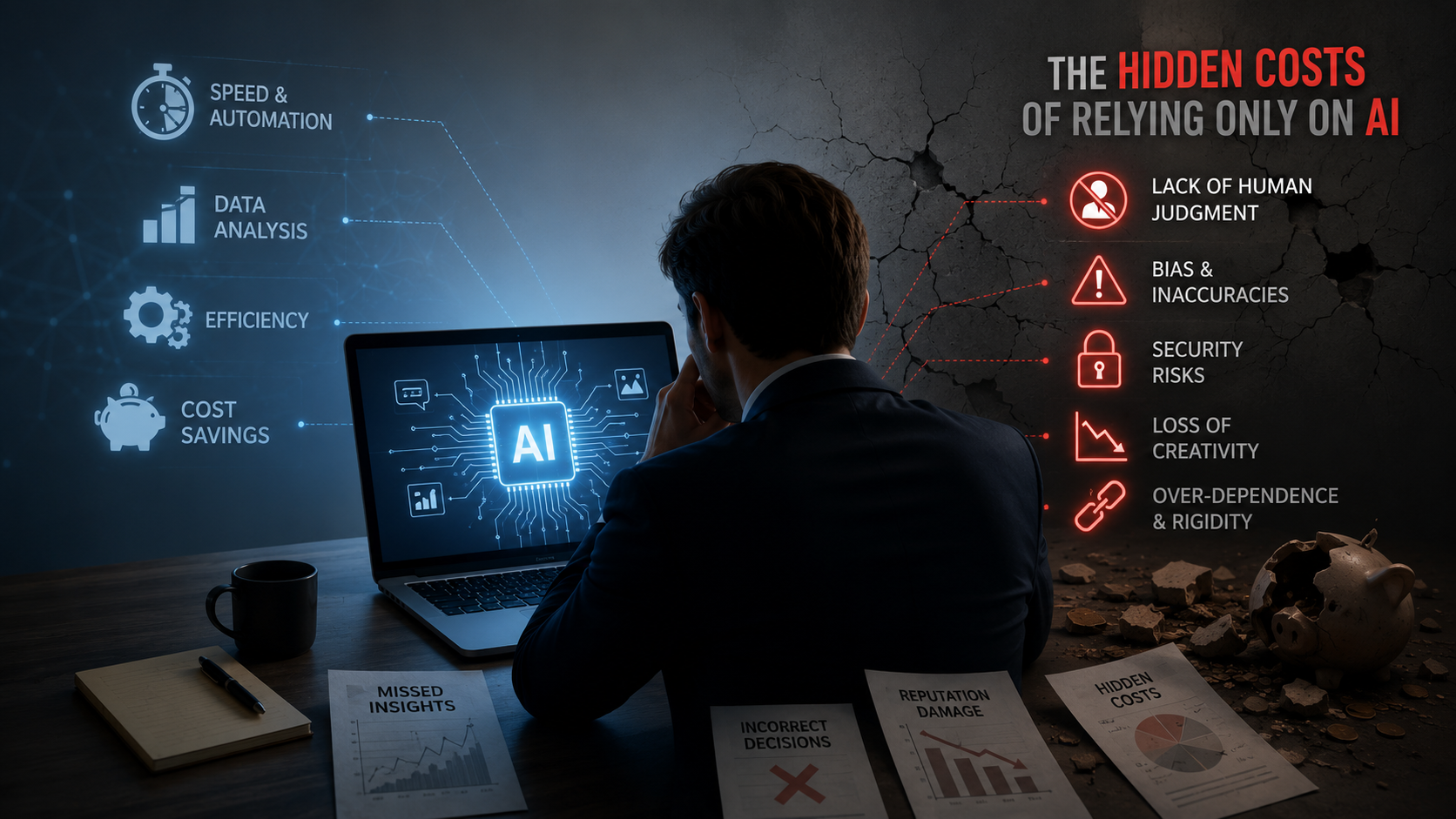
The Hidden Costs of Relying Only on AI for Your Business
AI tools promise speed and savings, but relying on them entirely comes with hidden risks and costs many businesses only discover too late. Here is what you need to know before going all-in.
AI Is Useful. Over-Reliance Is a Risk.
AI tools have made a lot of things easier for businesses. Writing, designing, customer support, code generation, data analysis, the list keeps growing. It is tempting to hand over as much as possible to AI and focus your human time elsewhere.
But there is a growing pattern among businesses that went too far too fast. They cut costs, reduced teams, and automated everything they could. Then they started noticing problems that were harder to fix than the costs they originally saved.
This is not an argument against using AI. It is a guide to the real costs that rarely appear in the tool's pricing page.
The Obvious Costs vs The Hidden Ones
When businesses think about AI tool costs, they usually think about subscription fees. That is the visible layer.
The hidden costs are different. They show up in quality, reputation, legal exposure, and missed opportunities. They are harder to measure but often more damaging in the long run.
| Cost Type | Visible AI Costs | Hidden AI Costs |
|---|---|---|
| Financial | Tool subscriptions, API fees | Corrections, rework, legal fees, quality failures |
| Operational | Setup time, integration work | Process breakdowns, missed context, human oversight gaps |
| Strategic | Vendor dependency | Loss of internal expertise, competitive sameness |
| Reputational | None initially | Trust erosion from errors, generic brand voice |
| Legal | Data privacy fees | IP ownership disputes, compliance violations, data leaks |
| Customer experience None initially | None initially | Poor personalisation, frustrating automated responses |

Hidden Cost 1: Quality Failures That Reach Your Customers
AI tools generate output based on patterns in their training data. They do not verify facts. They do not know what changed in your industry last week. They do not know the specific details of your business, your clients, or your local market.
When businesses remove human review from the process, errors make it to the customer.
Common examples:
- A blog post that contains an outdated statistic presented as current fact
- A customer service chatbot that gives the wrong answer about a product's return policy
- A legal document draft that misses a jurisdiction-specific clause
- Marketing copy that uses a phrase culturally inappropriate for the target audience
- A code snippet generated by AI that introduces a security vulnerability into a live product
Each of these errors has a cost. Sometimes it is just embarrassment. Sometimes it is a lost client. In regulated industries like healthcare, finance, or legal services, it can mean something far more serious.
Hidden Cost 2: The Loss of Internal Expertise
When a business automates a function entirely, the human knowledge behind that function starts to disappear. Team members stop practicing those skills. Institutional knowledge fades. New hires are never trained in the fundamentals.
This creates a dangerous dependency. If the AI tool changes its pricing, shuts down, loses quality, or becomes unavailable, the business has no fallback.
Where this becomes a serious problem:
- Content teams that have stopped developing writers who understand the brand
- Customer support teams where no one knows the products deeply because the chatbot handles everything
- Development teams where engineers no longer understand the code because AI wrote it
- Marketing teams where no one can build a strategy without prompting an AI tool
The short-term cost savings look good on a spreadsheet. The long-term cost of dependency and lost expertise does not show up until something breaks.
Hidden Cost 3: Legal and Compliance Exposure
This is one of the most underestimated risks of AI over-reliance, particularly in India where data privacy regulations are evolving rapidly.
Legal risks to be aware of:
- Intellectual property:AI tools generate content by learning from large datasets. The ownership of AI-generated content is still legally unclear in many countries. If your content accidentally reproduces protected material, you could face a copyright claim.
- Data privacy:Many AI tools process the inputs you feed them. If you are entering customer data, business-sensitive information, or personal employee records into these tools, you may be violating data protection agreements or regulatory requirements.
- Compliance in regulated industries:In sectors like fintech, healthcare, and legal services, AI-generated output must still comply with industry regulations. AI tools are not responsible for compliance. Your business is.
- Contractual obligations:Some client contracts have clauses about how work is produced. Delivering AI-generated work without disclosure could violate those agreements.
Hidden Cost 4: Generic Output in a Market That Rewards Differentiation
Every business that uses the same AI tool trained on the same data will tend to produce similar output. The same sentence structures, the same talking points, the same general tone.
When an entire industry starts using the same AI tools for content and marketing, everything starts to sound the same. That sameness is the enemy of brand differentiation.
How this affects your business:
- Your content looks and reads like every competitor's content
- You stop developing a distinctive brand voice that customers recognise
- Customers cannot tell you apart from alternatives, which makes price the only differentiator
- Your SEO results decline as AI-heavy content loses favour with search engines prioritising genuine expertise
For a branding agency or a web design agency, this is a core concern. Brand identity is built on being recognisably distinct. AI tools, by default, produce the average of everything they have been trained on. Average does not build a brand.
Hidden Cost 5: Customer Trust and Relationship Quality
Customers are getting better at recognising AI interactions. An automated email that lacks personal acknowledgement. A chatbot that loops without solving anything. A content piece that covers the topic but says nothing memorable.
Each of these interactions slightly reduces the trust a customer has in your business.
Signs AI over-reliance is damaging customer relationships:
- Customer satisfaction scores dropping despite faster response times
- Repeat customers disengaging without clear reason
- Social media comments pointing out generic or impersonal responses
- Reviews that mention "feeling like a number" or "automated and unhelpful"
- Higher churn rates in subscription or service-based businesses
Trust is built through consistent, thoughtful human interaction. It is lost gradually and recovered slowly.
Hidden Cost 6: Security and Data Risks
AI tools, particularly large language model-based tools, have specific security risks that businesses often underestimate.
Key security concerns:
- Confidential business strategies entered into public AI tools may be stored and used for training future models
- Proprietary code shared with AI coding tools may be retained and potentially exposed
- Customer data entered into AI tools may violate GDPR, India's DPDP Act, or industry-specific data regulations
- AI-generated code can introduce security vulnerabilities if not reviewed by qualified developers
- Phishing attacks using AI-generated content are becoming harder to detect
A software company or IT company running client infrastructure needs to be especially careful here. The cost of a single data breach almost always exceeds any operational savings from AI automation.
A More Balanced Approach
The goal is not to avoid AI. It is to use it in a way that captures the benefits without exposing your business to the hidden costs.
A practical framework:
| Business Function | Where AI Helps | Where Humans Must Stay Involved |
|---|---|---|
| Content creation | Research, first drafts, formatting | Strategy, editing, final approval, original insight |
| Customer support | FAQ responses, routing, basic queries | Complex problems, complaints, relationship management |
| Software development | Code suggestions, boilerplate, testing support | Architecture decisions, security review, client-specific logic |
| SEO and marketing | Keyword research, reporting, drafts | Strategy, brand voice, campaign judgment |
| Legal and compliance | Research, template drafts | Final review, filing, client advice |
| Data analysis | Processing, pattern identification | Interpretation, decision-making, stakeholder communication |
Frequently Asked Questions
Not at all. AI tools used thoughtfully with proper human oversight are genuinely valuable. The risk is removing the human layer entirely and assuming AI output is ready to use without review.
Ask these questions. Is anyone reviewing AI output before it reaches customers? Do your team members still have the skills to do key tasks without AI? Are you storing sensitive data in AI tools? If the AI tool went offline tomorrow, could you still operate? Gaps in these answers signal over-reliance.
Regulated industries such as healthcare, finance, legal, and education face the highest risk because compliance requirements do not disappear just because AI was used. Brand-sensitive businesses like agencies, consultancies, and premium service providers also face significant risk to their reputation.
It can. Google's quality guidelines increasingly reward content that demonstrates real experience, expertise, authority, and trustworthiness (E-E-A-T). Content that is purely AI-generated often lacks these signals. A well-optimised content strategy uses AI as a tool, not a replacement for genuine expertise.
The Bottom Line
AI tools are genuinely useful additions to any modern business. The businesses that benefit most from them are the ones that deploy AI strategically, maintain strong human oversight, and never let automation replace the judgment, relationships, and expertise that actually build something worth trusting.
The hidden costs of over-reliance are real. Catching them early is significantly less expensive than cleaning them up after they have caused damage.
If you want to build a technology or marketing strategy that uses AI where it helps and keeps humans where they matter, Bhanguz Software Solutions Pvt. Ltd. can help you find the right balance. Contact us to discuss your specific requirements.
Written by the team at Bhanguz Software Solutions Pvt. Ltd., an IT company in Mohali with 19+ years of experience in software development, digital marketing, and technology consulting for businesses across India and internationally.
Related articles

Published June 11, 2026
How Bhanguz Builds Powerful Offshore Web Solutions Using MEAN, MERN, PHP & Flutter
 Author Name
4 min read

Published May 14, 2026
How Bhanguz Conducts Requirement Analysis for Every Project
Author Name
4 min read
